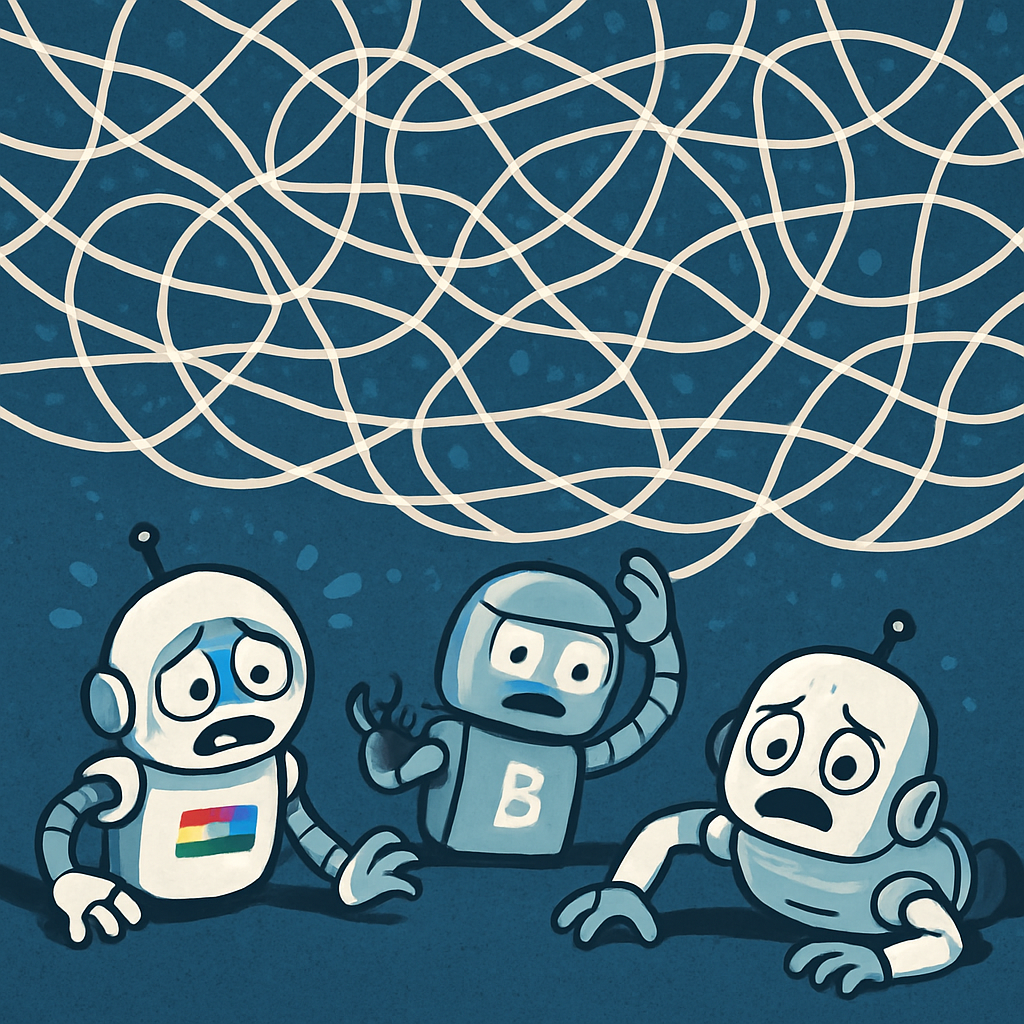
🌍 The Web’s Growing Faster Than Google Can Keep Up. Where Does That Leave Your Website?
By Mariana Franco
Let’s be blunt: the web is a mess.
Every second, thousands of new pages go live, most of them rehashed, AI-generated, or written purely for empty clicks. And while search engines used to reward this volume, the game is changing fast.
So here’s the real question:
Can search engines keep crawling and indexing everything forever?
And more importantly: should your brand keep publishing content like it’s 2012?
🕷️ The Crawling Crisis: Too Much Web, Too Little Value
Google’s crawlers are tired. (Okay, not literally, but the systems behind them are.)
With the explosive growth of AI content, we’re reaching a point where most new pages are not adding anything new. They’re just remixing existing info, trying to capture traffic before the next algorithm update hits.
As Jason Barnard put it:
“You’re asking the machine to create content it doesn’t understand, then republishing it under your name—and that same machine later reads it as if it were truth.”
It’s a loop. A loop of misinformation, hallucinated data, and “content” that doesn’t fill any information gap. And eventually, search engines will stop bothering with it.
🤖 Search Engines Will Get Pickier Faster
We’re heading toward a future where search engines only invest crawling and indexing power into sites that add real value, whether to humans or machines.
This means:
- You might still rank… for now.
- But if your site never provides fresh information or unique perspective, you’ll be ignored long-term.
It’s not about writing better listicles. It’s about feeding the machines new facts, new connections, and new context.
🔥 Originality means Indexing Fuel
Here’s the reality:
If your content isn’t original, it’s invisible to the future.
Search engines will increasingly favor:
- Entities that consistently provide new or nuanced info
- Pages that fill information gaps not yet covered in the knowledge graph
- Brands that help the machine learn something new
This doesn’t mean you can’t cover existing topics. But it means you need to bring your own lens, your own data, your own value. And most importantly, you need to think beyond just ranking.
🚫 The Death of Empty Top-of-the-Funnel Content
Let’s talk about fluff.
That endless stream of “What is SEO?” or “Top 10 Tips for X” that gets published only because a keyword tool said so.
Here’s the thing:
Top-of-the-funnel content won’t disappear. But the kind that ranks purely because it exists? That’s dying.
ChatGPT and similar tools will satisfy most broad, generic intent in seconds. That leaves brands with a choice:
Either create top-of-funnel content that’s truly useful to humans,
or stop wasting time writing for robots that stopped reading.
But let’s be clear: this doesn’t mean you should abandon TOFU content.
It means the way you do it needs to evolve.
High-quality, top-of-funnel content is still essential, not just for traffic, but for building your brand’s expertise.
It’s how you:
- Show up early in the buyer journey
- Demonstrate authority across your niche
- Train the machines (and the humans) to see you as the go-to source
In the future, that’s what earns you a seat in the SERP, the AI summary, or the assistant’s response.
Not the fact that you wrote another “how to do keyword research” article.
🧠 Build a Future-Ready Content Strategy
If you want to be visible in the next wave of search and AI assistants, here’s what to focus on:
1. Create Content That Teaches Machines
- Who you are
- What you do
- Who you serve
- Why you matter
Educate the machine, not just your reader. Use consistent facts. Back it up with schema. Align your content across platforms (website, LinkedIn, YouTube, etc.).
2. Write for Information Gaps
Don’t just rephrase. Ask:
- What hasn’t been said yet?
- What unique experience, data, or expertise can we offer?
- What would make this page essential to crawl?
3. Use Your Digital Footprint as a Content Distribution System
Your website is one touchpoint. But Google and Bing are looking at your entire footprint:
- Articles on third-party platforms
- Podcast mentions
- Structured data in your schema
- Mentions on authoritative sources
Own your brand across the web, and the crawlers will follow.
4. Think Beyond Google
Bing, Perplexity, Gemini, ChatGPT: these tools are becoming discovery engines in their own right. And they’re powered by fresh data and structured signals.
Which leads to…
🧩 Bonus: Should You Use IndexNow?
Google is still crawling based on discovery. Bing? It’s already asking you to push your new content directly to them through IndexNow.
That’s a win for visibility, freshness, and carbon efficiency.
If you’re using WordPress, Wix, or Cloudflare, it’s probably already available to you.
💡 So… Should You Keep Publishing Content?
Yes! Just stop publishing crap.
- Write less. Think more.
- Focus on educating both humans and machines.
- Treat every article as part of your entity, your brand story.
Because the machines are getting selective. And soon, they might not even knock on your door.
📌 TL;DR (Or: What the Crawlers Will Remember)
- Search engines can’t keep indexing every new piece of fluff.
- AI-generated content loops are confusing the machines.
- Unique, useful, entity-driven content is the only thing that will matter.
- Top-of-funnel fluff will be handled by ChatGPT, humans need better.
- Your digital footprint, not just your website, shapes your future visibility.
Want your content to be future-proof?
Let’s talk content strategy for the next wave of search.
Or reach out for a brand-focused SEO audit and we’ll show you what your site is teaching the machines today.
Watch: Can Search Engines Keep Crawling and Indexing The Growing Web?
In this conversation with Jason Barnard, we dive deeper into how search engines are handling the growing overload of content, and what that means for brands trying to stay visible. From crawling limitations to content strategy mistakes, here’s the full discussion.
